
Gap Cover
What Is Gap Cover?
Medical Expense shortfalls are a reality. Don’t be burdened with unexpected medical fees when your doctor charges more than the medical aid rate for in-hospital treatment, or the hospital charges co-payments for operations.
Gap cover is a short-term insurance product that helps protect you from medical expense shortfalls, which happen when your doctor charges more than the medical aid rate for in-hospital treatment, or the hospital charges co-payments for operations. These unanticipated expenses can leave you with an unexpected financial burden that you will have to pay for out of pocket. With rampant medical inflation and the cost of medical procedures constantly increasing, this could easily run into hundreds of thousands of Rands.
As medical aids are under constant pressure to balance benefits with affordable contributions, they have had to resort to creative strategies to attempt to maximise coverage. This means that co-payments now exist where previously there were none, and members are now being restricted to using certain providers at certain networks, with penalties applied if patients go outside of these networks.
Gap cover should be part of your financial planning no matter your age or life stage. It is never too early to start thinking about your financial future, because the sooner you start the more time you have to plan, save and invest. Effective financial planning is essential whether you are in your 20s, your 80’s or any age in between, and this does not just mean having retirement annuities in place. With the rising cost of medical treatment and increasing shortfalls in medical aid cover, medical expenses can easily become a burden, and while you are typically young and healthy earlier in life, accidents happen and the older you get, the more likely you are to need costly medical treatment. Gap cover has become a vital part of a comprehensive financial planning toolset, no matter what your current age or life stage is.
How Does It Work?
Co-payment Cover
A co-payment or deductible is an upfront amount that needs to be paid to the:
- Hospital
- Radiologist
- Day Clinic
before undergoing certain procedures, as specified by your Medical Scheme. When you experience a co-payment for a procedure or scan (as specified by your Medical Scheme) you would need to pay for the co-payment up-front and then claim the amount back from your Turnberry Policy (provided that the plan you selected offers co-payment cover).
- Premier
- Optimal
- Synergy
- Launch
- Med-Extend
Non-DSP Hospital Cover
Should you choose to go to a hospital or day clinic outside of your Medical Scheme’s Hospital Network/ Designated Service Providers, you would be liable for a portion of the account, as specified by your Medical Scheme. Example: Henry’s Medical Scheme stipulates that he needs to go to hospital X, if he chooses to go to another hospital he would need to pay the first R8 700 of the hospital account. Henry chooses to go to hospital Y and pays the R8 700 and then claims it back from his Turnberry Premier Policy.
- Premier
- Optimal
- Synergy
- Launch
- Med-Extend
Medical Expense Shortfall Cover
A Medical Expense Shortfall is the difference between what medical service providers (e.g. Doctors, basic and specialised Radiology, Pathology, Specialists, Consumables) charge and what Medical Schemes pay for the treatment performed in hospitals and day clinics, provided that it is paid from the Hospital Benefit or risk benefit of the Medical Scheme.
-
Amount Charged by
Healthcare Providers -
Amount Paid by
Medical Schemes - Medical Expense Shortfalls
Medical Expense Shortfall Cover includes cover for:
Specialists, Basic and specialised Radiology, Physiotherapy, Consumables (e.g. plasters, cotton wool etc), Pathology, Prescribed Minimum Benefits
- Premier = 600%
- Optimal = 500%
- Synergy = 500%
- Launch = 350%
- Med-Extend = 300%
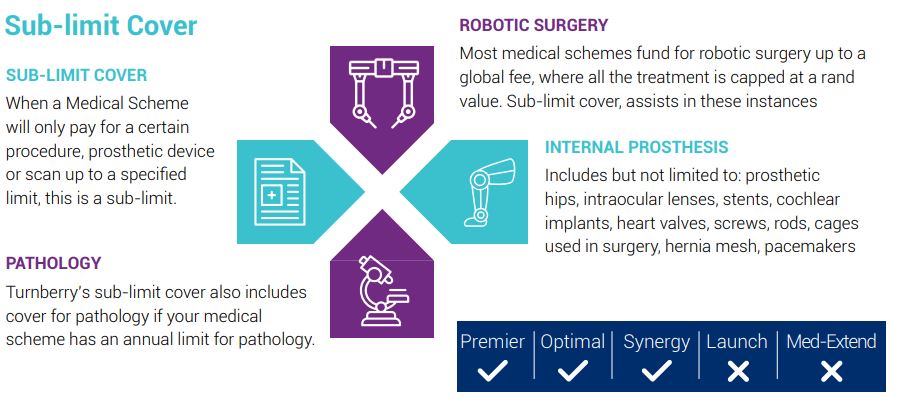
Sub-limit Cover
Traditional Cancer Cover
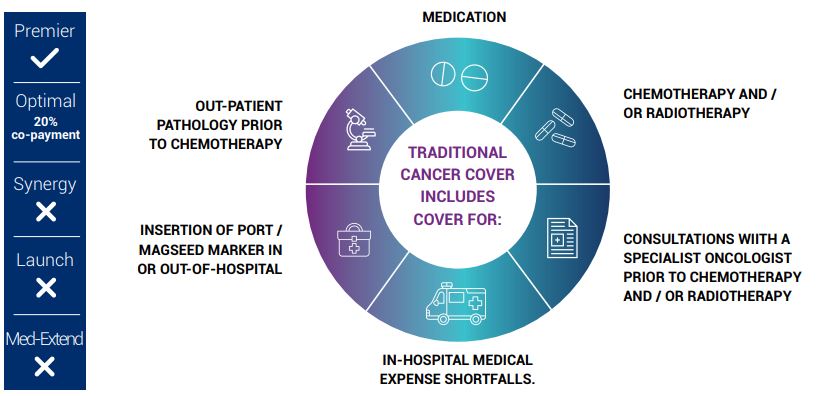
If you have depleted your cancer benefit on your Medical Scheme, you may become liable for co-payments or the full cost of any further cancer treatment, as specified by your Medical Scheme.
Example 1:
Johan who has lung cancer has finished his R250 000 cancer benefit available to him on his Medical Scheme and now he is liable for the full cost of his cancer treatment. Johan still needs to undergo chemotherapy sessions. Luckily, he has a Turnberry Premier Policy and he can submit the costs of his further chemotherapy sessions to Turnberry.
Example 2:
Deon has finished his R250 000 cancer benefit available to him on his Medical Scheme and still needs to undergo chemo[1]therapy. His Medical Scheme will pay for 80% of the account for his chemotherapy. Deon is glad he listened to his Financial Advisor and took out a Turnberry Optimal Policy, now he can submit the account to Turnberry.
Biological Cancer Drug Cover
When you require treatment with Biological Cancer Drugs your Medical Scheme may only pay for them up to a certain limit. The following Drugs are covered on Premier and Optimal only:
Herceptin
Mylotarg
Nexavar
Gleevec
Sprycel
Faslodex
Velcade
Tarceva
Alimta
Zevalin
Avastin
Erbitux
Sutent
Fludara
Mabthera
- Premier
- Optimal
- Synergy
- Launch
- Med-Extend
Innovative Cancer Cover
Recently the development of new cancer drugs have become available e.g. Immunotherapy. It is important to note that there has to be a benefit from the medical scheme. The Innovative Cancer Cover will provide R11 000 cover per claim for these new high cost cancer drugs. These drugs are extremely high cost and are not fully funded by medical schemes leaving members out-of-pocket.
- Premier
- Optimal
- Synergy
- Launch
- Med-Extend